Note
Go to the end to download the full example code.
Depth Overlay 1
Example (and test) for behavior of the depth buffer w.r.t. overlays, implemented by multiple render calls. The overlay should always be on top.
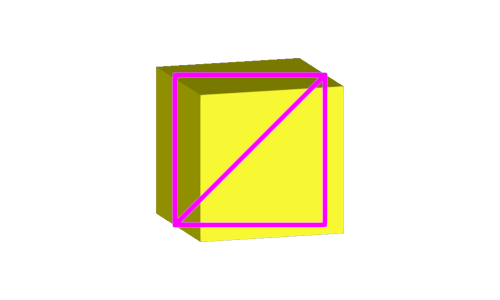
import numpy as np
from rendercanvas.auto import RenderCanvas, loop
import pygfx as gfx
import pylinalg as la


# Create a canvas and renderer

canvas = RenderCanvas(size=(500, 300))
renderer = gfx.renderers.WgpuRenderer(canvas)

# Compose a scene with a 3D cube at the origin

scene1 = gfx.Scene()

cube1 = gfx.Mesh(
    gfx.box_geometry(),
    gfx.MeshPhongMaterial(color="#ff0"),
)
rot = la.quat_from_euler((0.2, 0.3), order="XY")
cube1.local.rotation = la.quat_mul(rot, cube1.local.rotation)
scene1.add(cube1)

# Compose a scene with a 2D square at the origin, in the xy plane

scene2 = gfx.Scene()

positions = np.array(
    [
        [-1, -1, 0.0],
        [-1, +1, 0.0],
        [+1, +1, 0.0],
        [+1, -1, 0.0],
        [-1, -1, 0.0],
        [+1, +1, 0.0],
    ],
    np.float32,
)
line2 = gfx.Line(
    gfx.Geometry(positions=positions * 0.5),
    gfx.LineMaterial(
        thickness=5.0, color="#f0f", depth_test=False, depth_write=False, aa=True
    ),
)
scene2.add(line2)

# Camera

camera = gfx.OrthographicCamera(2, 2)
scene1.add(camera.add(gfx.DirectionalLight()))


def draw():
    renderer.render(scene1, camera, flush=False)
    renderer.render(scene2, camera, flush=False)
    renderer.flush()


canvas.request_draw(draw)

if __name__ == "__main__":
    print(__doc__)
    loop.run()
Total running time of the script: (0 minutes 0.166 seconds)
Gallery generated by Sphinx-Gallery
Interactive example
Try this example in your browser using Pyodide. Might not work with all examples and all devices. Check the output and your browser’s console for details.