Note
Go to the end to download the full example code.
Wireframe 2
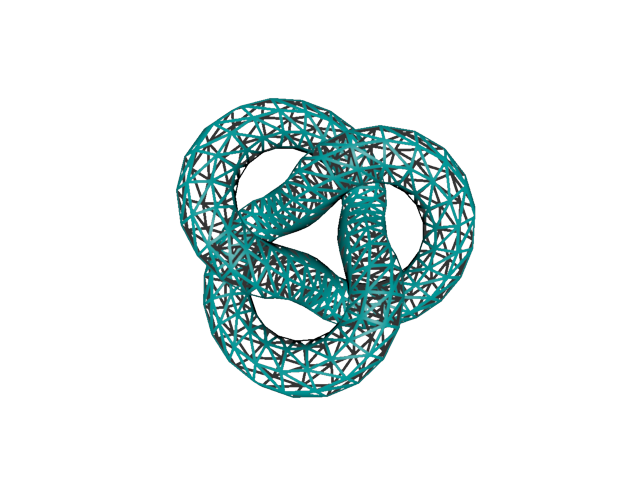
Example showing a Torus knot, as a wireframe. We create two wireframes, one for the front, bright blue and lit, and one for the back, unlit and gray.
from rendercanvas.auto import RenderCanvas, loop
import pygfx as gfx
import pylinalg as la


canvas = RenderCanvas()
renderer = gfx.renderers.WgpuRenderer(canvas)
scene = gfx.Scene()

geometry = gfx.torus_knot_geometry(1, 0.3, 64, 8)

material1 = gfx.MeshBasicMaterial(
    color=(0.2, 0.2, 0.2, 1.0), wireframe=True, wireframe_thickness=3, side="back"
)
obj1 = gfx.Mesh(geometry, material1)
scene.add(obj1)

material2 = gfx.MeshPhongMaterial(
    color=(0, 0.8, 0.8, 1), wireframe=True, wireframe_thickness=3, side="front"
)
obj2 = gfx.Mesh(geometry, material2)
scene.add(obj2)

camera = gfx.PerspectiveCamera(70, 1)
camera.local.z = 4

scene.add(gfx.AmbientLight(0.2), camera.add(gfx.DirectionalLight(0.8)))


def animate():
    rot = la.quat_from_euler((0.0071, 0.01), order="XY")
    obj1.local.rotation = la.quat_mul(rot, obj1.local.rotation)
    obj2.local.rotation = la.quat_mul(rot, obj2.local.rotation)

    renderer.render(scene, camera)
    canvas.request_draw()


if __name__ == "__main__":
    canvas.request_draw(animate)
    loop.run()
Total running time of the script: (0 minutes 0.286 seconds)
Gallery generated by Sphinx-Gallery
Interactive example
Try this example in your browser using Pyodide. Might not work with all examples and all devices. Check the output and your browser’s console for details.